💡 EnggWave Expert Analysis (April 2026):
For the last decade, the advice for every Mechanical or Electrical student was simple: “Learn Java and get into IT.” But in 2026, that script has flipped.
While entry-level “generic” coding roles are being heavily disrupted by AI agents and mass-recruiter slowdowns, India’s Core sectors—Semiconductors, EVs, and Green Energy—are experiencing a historic hiring surge. For the first time in years, the “Stability Gap” is closing. In this 2026 update, we break down why a VLSI or Power Systems specialist may now have a more “AI-proof” career path than a traditional Full-Stack developer.

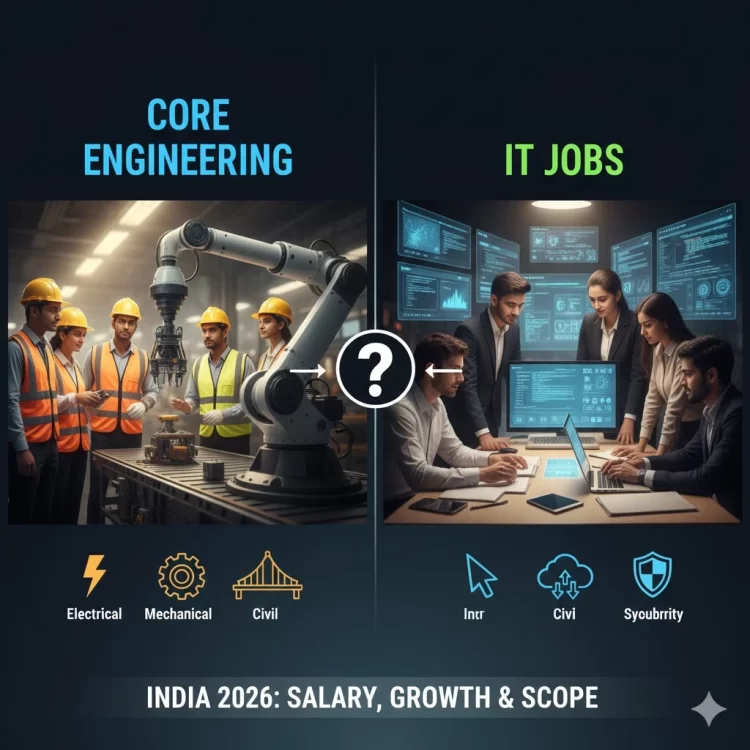
Core Engineering vs IT Jobs
One of the biggest dilemmas faced by engineering students in India today is: Should I stick to a core engineering job or switch to the IT sector?
Whether you are from Mechanical, Civil, Electrical, or Electronics, this confusion is natural. With the rise of Industry 4.0 and Artificial Intelligence, the lines between these sectors are blurring. Let’s analyze both options practically.
🏗️ Understanding Core Engineering Jobs
Core engineering roles relate directly to your branch of study. In 2026, “Core” doesn’t just mean factories; it includes high-tech R&D.
Mechanical: Robotics, EV (Electric Vehicles), Manufacturing, HVAC.
Civil: Smart City Infrastructure, Structural Engineering, Green Building.
Electrical/ Electronics: VLSI, Embedded Systems, Renewable Energy, 6G Communication.
The Pros & Cons of Core
| Advantages | Challenges |
| Domain Expertise: You become a specialist in a niche field. | Slow Start: Entry-level salaries are often lower (₹3–5 LPA). |
| Job Stability: Core industries are less volatile than the tech market. | Location: Jobs are often in industrial hubs (Pune, Hosur, Jamshedpur). |
| PSU Opportunities: Eligibility for GATE, IES, and high-paying PSU roles. | Work Environment: May involve shop-floor or site work. |
💻 Understanding IT Jobs for Engineers
The IT sector remains the largest recruiter of freshers in India. Today, companies aren’t just looking for “coders”—they want problem solvers.
Key Roles in 2026:
AI/ML Engineer: Building smart systems.
Full-Stack Developer: Handling both frontend and backend.
Data Scientist: Analyzing big data for business decisions.
Cybersecurity Analyst: Protecting digital assets.
The Pros & Cons of IT
| Advantages | Challenges |
| High Starting Pay: Roles like TCS Digital or Product startups pay ₹7–12 LPA. | High Obsolescence: You must learn new tools every 2 years. |
| Flexibility: Higher chances of Remote Work or Hybrid models. | Burnout: High-pressure environments and tight deadlines. |
| Rapid Growth: Frequent appraisals and switches can double your salary. | Screen Time: 9–10 hours in front of a computer daily. |
⚖️ How to Choose? (The 3-Point Filter)
 1. The Interest vs. Logic Test
Don’t choose IT just for the money. If you find coding frustrating but love designing engine parts in SolidWorks, you will likely burn out in an IT job within two years.
2. The “Hybrid” Middle Ground
The best path in 2026 is often Hybrid
- Mechanical + Python = Robotics/ Automations Engineer.
- Electrical + Embedded C = EV Battery Management Specialist.
- Civil + Data Analytics = Construction Project Manager.
3. Market Reality
While IT has more volume (more jobs), the Core sector is facing a talent shortage. Skilled VLSI or Power Electronics engineers are now getting salaries that rival top-tier IT roles.
🚀 Smart Strategy for Students (2nd & 3rd Year)
Master One Core Software: (e.g., AutoCAD, MATLAB, or Revit).
Learn One Programming Language: (Python is the best bridge between Core and IT).
The Internship Pivot: Try to do one core internship and one tech-based project to see which “stress” you prefer handling.
❓ FAQ: Frequently Asked Questions
Q1: Can a Civil/Mechanical engineer get a high-paying IT job?
A: Yes. Most IT giants (TCS, Infosys, Accenture) care more about your aptitude and logic than your degree. However, for product companies (Google, Amazon), you will need strong Data Structures & Algorithms (DSA) skills.
Q2: Is the Core sector “dying” in India?
A: Far from it. With the “Make in India” initiative and the shift to Green Energy, core engineering is seeing a massive resurgence in R&D and specialized manufacturing.
Q3: Which sector has better long-term growth?
A: IT has a steeper growth curve in the first 5 years. Core engineering has a “hockey stick” growth curve—slower initially, but once you become a “Subject Matter Expert” (10+ years), your value becomes irreplaceable.
🚀 Join the Enggwave Community!
Get instant alerts for Engineering Jobs, MNC, OEM, Govt & PSU jobs and career guidance directly on your phone.
Follow us on social media for daily updates: