
Most often asked Interview Questions with Answers on Structural Analysis/ Finite Element Analysis
The interview questions asked for an Engineer on Structural Analysis / Finite Element Analysis are:
1. Define Stress?
Answer: The force per Unit area is called Stress.
Stress = Applied force ( load) / Cross Sectional Area
When an External force is applied on a body gets deformed, due to this deformation an internal resistance force develops on a perpendicular plane area of a body. This internal resistance force per unit cross-sectional area is called Stress.
2. Define Strain?
Answer: The Strain is defined as the ratio of change in dimension to the original dimension
3. Define Young’s modules?
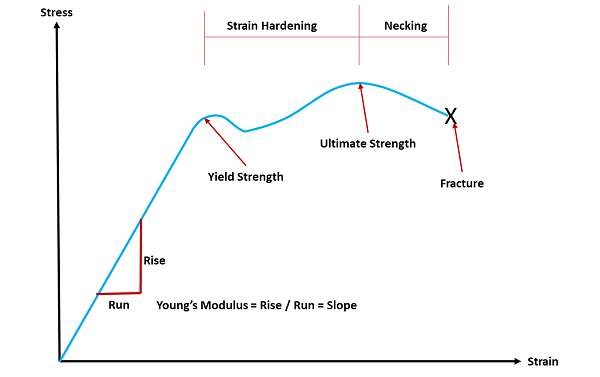
Answer: The Young’s modulus (E) is a property of the material that tells us how easily it can stretch and deform and is defined as the ratio of tensile stress (σ) to tensile strain (ε)
4. Define Rigidity modules?
Answer: Shear modulus, also known as Modulus of rigidity, is the ratio of shear stress to shear strain that determines the rigidity of a body.
5. Define Bulk modules ?
Answer: Bulk modulus is a numerical constant that describes a solid’s or fluid’s elastic properties when it is under pressure on all sides. When pressure is applied to a material, it reduces its volume, which then returns to its original volume when the pressure is removed.
6. Define Stiffness ?
Answer: Stiffness is the extent to which an object resists deformation in response to an applied force.
7. Define Linear and non linearity?
Answer: A linear analysis uses only linear elastic materials and small displacements (infinitesimal strain theory), whereas a non-linear analysis uses large displacements and Elastoplastic materials, the superposition effect cannot be used. The stiffness matrix is another significant distinction.
8. What is Natural frequency?
Answer: A natural frequency is defined as that frequency at which a body will vibrate if excited by an external force.
When an object vibrates at a frequency equivalent to its natural frequency, the vibration of the amplitude increases significantly which could lead to irreparable damage, therefore, it is important to know the natural frequency
9. What is Resonant frequency?
Answer: The natural frequency of an object, where it tends to vibrate at a higher amplitude, is also known as the resonant frequency. For example, if the collective oscillation force from automobiles caused a bridge to vibrate at its frequency, you may feel it “shake.”
10. Define Damping ?
Answer: damping, in physics, restraining of vibratory motion, such as mechanical oscillations, noise, and alternating electric currents, by dissipation of energy.
11. Draw a Stress and strain curve
12. Explain the properties of materials?
Hardness – Hardness is the resistance to scratching, cutting or abrasion.
Toughness – Toughness is the resistance to fracturing and this quality depends on the maximum energy that can be absorbed before fracturing
Brittleness – Brittle substances are liable to break easily. These substances are hard, and cannot be hammered or stretch like ductile substances; instead, they break
Ductility – Ductile substances can be easily hammered or stretched into thin wires without breakage. This physical property is explained as ductility.
Malleability – capability of being shaped or extended by hammering, forging, etc.
Strength – the ability of a material to resist mechanical forces when in use. A material’s strength in a given application depends on many factors, including its resistance to deformation and cracking, and it often depends on the shape of the member being designed.
13. What is the purpose of finding natural frequency? How do you find natural frequency?
Answer: When an object vibrates at a frequency equivalent to its natural frequency, the vibration of the amplitude increases significantly which could lead to irreparable damage, therefore, it is important to know the natural frequency.
Natural Frequency Calculator
f = sqrt ( k / m ) / 2*π …..”Hz”
k – Spring Constant (N/m)
m – Mass of Spring (kg)
14. What Is Meant By Finite Element Method?
Answer: Finite element method (FEM)is a numerical technique for solving boundary value problems in which a large domain is divided into smaller sections or elements. The solution is determined by assuming certain polynomials. The small elements are called finite element and the polynomials are called shape functions.
15. List Out The Advantages Of Fem?
Answer: Since the properties of each element are evaluated separately, different material properties can be incorporated for each element.
- There is no restriction in the shape of the medium.
- Any type of boundary condition can be adopted.
16. Mention The Various Coordinates In Fem?
Answer:
- Local coordinates
- Natural coordinates
- Simple natural coordinates
- Area coordinator Triangular coordinates
- Generalized coordinates
17. What Are The Basic Steps In Fem?
Answer :
- Discretization of the structure
- Selection of suitable displacement function
- Finding the element properties
- Assembling the element properties
- Applying the boundary conditions
- Solving the system of equations
- Computing additional results
18. What Is Discretization?
Answer: Discretization is the process of subdividing the given body into a number of elements which results in a system of equivalent finite elements.
19. What Are Different Types Of Elements Used In Fem?
Answer: The various elements used in FEM are classified as
- One dimensional elements (1D elements)
- Two dimensional elements (2D elements)
- Three dimensional elements (3D elements)
20. Why should one use finite elements?
Answer: The use of finite elements allows the modeling of multiple material types, testing of complex geometry, and the ability to capture local effects acting on a small area of the design. In practice, engineers can use finite element modeling software on a huge variety of tasks.
21. What is meant by node or Joint?
Answer: Each kind of finite element has a specific structural shape and is inter- connected with the adjacent element by nodal point or nodes. At the nodes, degrees of freedom are located. The forces will act only at nodes at any others place in the element.
22. What are the types of boundary conditions?
Answer: Types of Boundary Conditions are
- Dirichlet Boundary Condition.
- Neumann Boundary Condition.
- Robin Boundary Condition.
- Mixed Boundary Condition.
- Cauchy Boundary Condition.
23. What are the three phases of finite element method?
Answer: There are three initial phases in FEA which are
(1) classification of the problem,
(2) discretization and
(3) modelling.
24. what is meant by DOF?
Answer: The degrees of freedom (DOF) of a mechanical system is the number of independent parameters that define its configuration or state. It is important in the analysis of systems of bodies in mechanical engineering, structural engineering, aerospace engineering, robotics, and other fields.
25. Types of analysis in FEA?
Answer: Types of Analysis are, Structural analysis, Thermal analysis, Fluid analysis, Heat transfer analysis, Electromagnetic analysis, Buckling analysis, Electrical analysis, and Multi physics analysis (coupled field).
🚀 Join the Enggwave Community!
Get instant alerts for Engineering Jobs, MNC, OEM, Govt & PSU jobs and career guidance directly on your phone.
Follow us on social media for daily updates: